holding our public officials accountable
NYC Greenways Coalition Releases NYC Greenways Scorecard
NYC Greenways Coalition — the alliance of more than 50 policy non-profits and all-volunteer community groups across New York City — is excited to release the NYC Greenways Scorecard. From the First 100 Days, through the First Year, and through the First Term, the scorecard is a living tool to identify priorities for the administration to advance the work of improving and expanding greenways significantly.
The scorecard will publicly track progress and keep policymakers, public officials, and agencies accountable.
We’re committed to a greenway network that is well-designed, well-maintained, connects neighborhoods across the city, and is expanded into underserved communities. On foot and on wheels, greenways can be the most affordable way to get around New York City. A well-designed greenway system — that connects communities and boroughs and provides lush greenspace separated from motor vehicles for people walking and rolling — makes New Yorkers of all ages, abilities, incomes, and backgrounds healthier (physically and mentally), safer, freer, and more prosperous.
We see the NYC Greenways Coalition scorecard as an implementation plan for the NYC Greater Greenways Plan, the first citywide greenways plan in over three decades.
WHAT IS A GREENWAY?
In New York City, a greenway is defined as a linear public space that spans communities and links neighborhoods, parks, job centers, and other destinations. A greenway provides abundant space for people walking, biking, running, rolling, or not moving at all. People of all abilities and ages should feel welcomed on New York’s greenways and be safely protected from automobiles by permanent, physical separation. A greenway connects people to their environment using ecological elements such as trees and/or restored waterfront access.
CITYWIDE PRIORITIES: FIRST 100 DAYS
Establish a Greenway Task Force overseen by the Deputy Mayor for Operations or other appropriate position within the Mayor’s Office and commit to fully funding DOT and Parks’ greenway teams- Empower agencies to make existing greenways safe, accessible, and beautiful through the following:
> Create “where and when” contract for Parks to repave high-priority/dilapidated greenways and fill gaps in tree cover; post maintenance schedule on DOT’s Greater Greenways website.
> Set clear designations for agency/department responsibility for maintaining and trimming back greenery along greenways and protected bike lanes, with aggressive schedules that coordinate with growing seasons
> Fund and complete at least one high-priority maintenance project within the first 100 days - Amend the Waterfront Access Plan zoning text to explicitly require continuous right-of-way for a dedicated bicycle and pedestrian path on or adjacent to parcels along corridors identified for waterfront greenways in the NYC Greater Greenways Plan
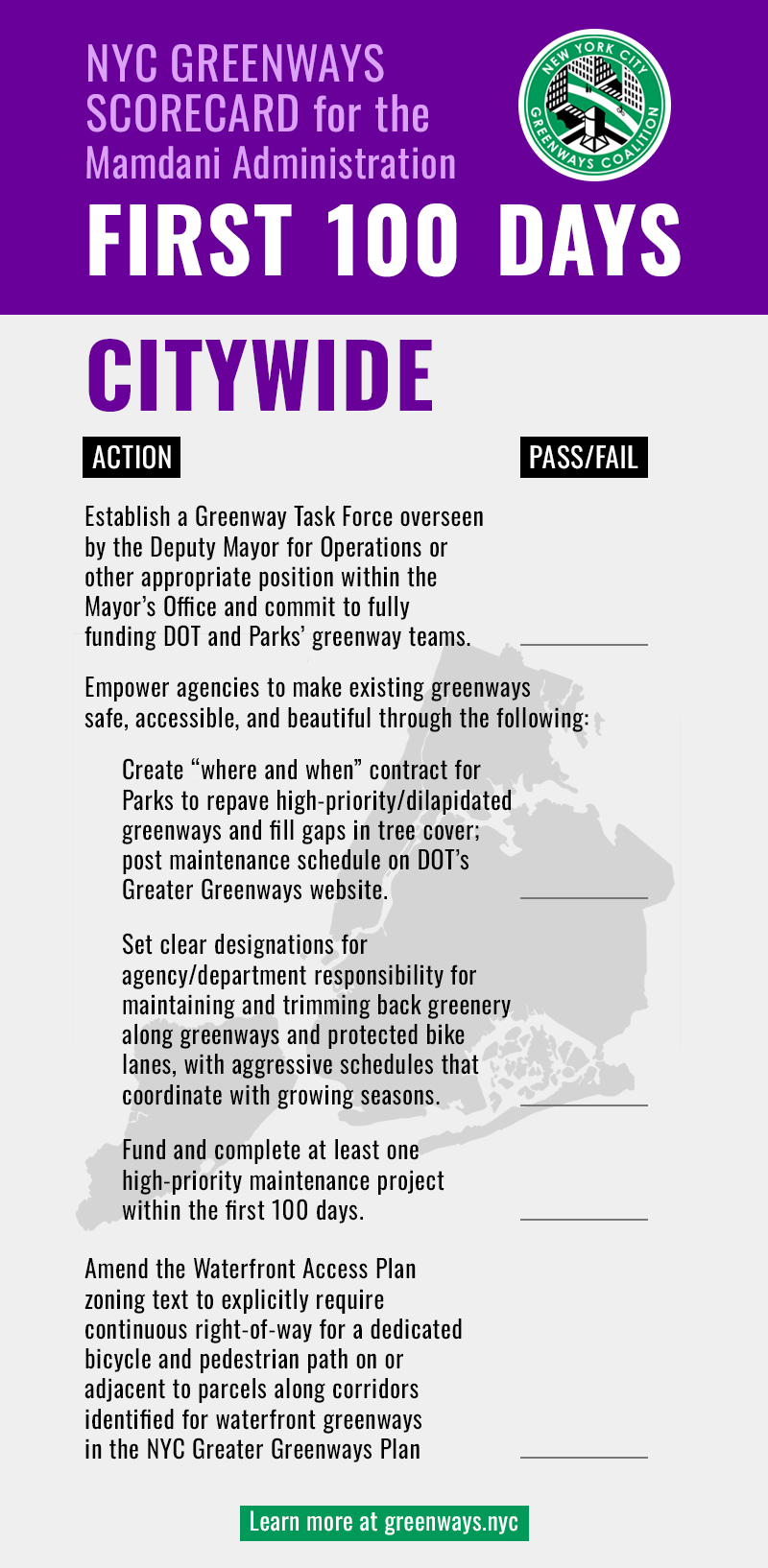
Click on the image to view the scorecard of citywide priorities.
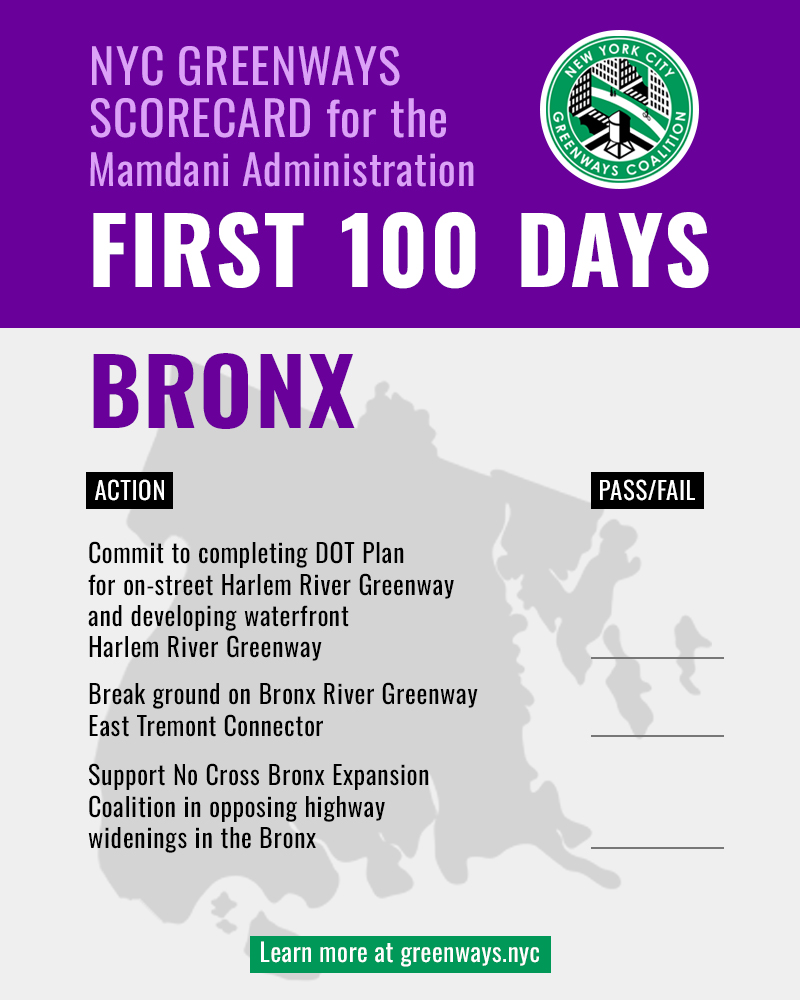
BY BOROUGH: FIRST 100 DAYS
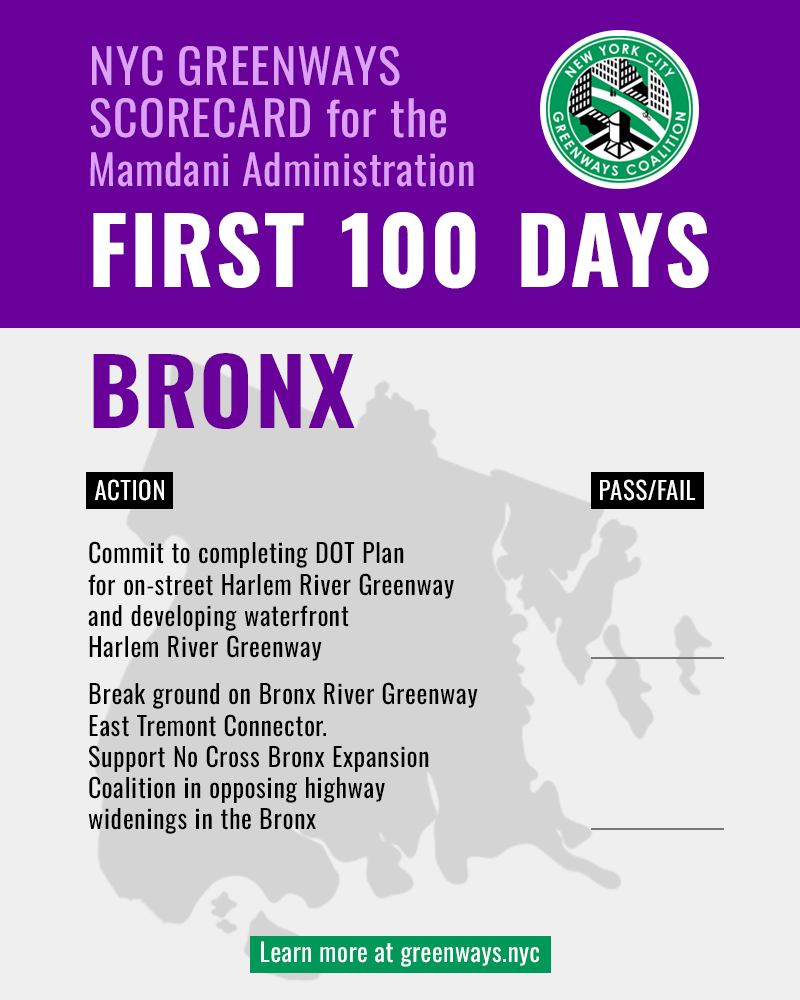
THE BRONX
- Commit to completing DOT Plan for on-street Harlem River Greenway and developing waterfront Harlem River Greenway
- Break ground on Bronx River Greenway East Tremont Connector
- Support No Cross Bronx Expansion Coalition in opposing highway widenings in the Bronx
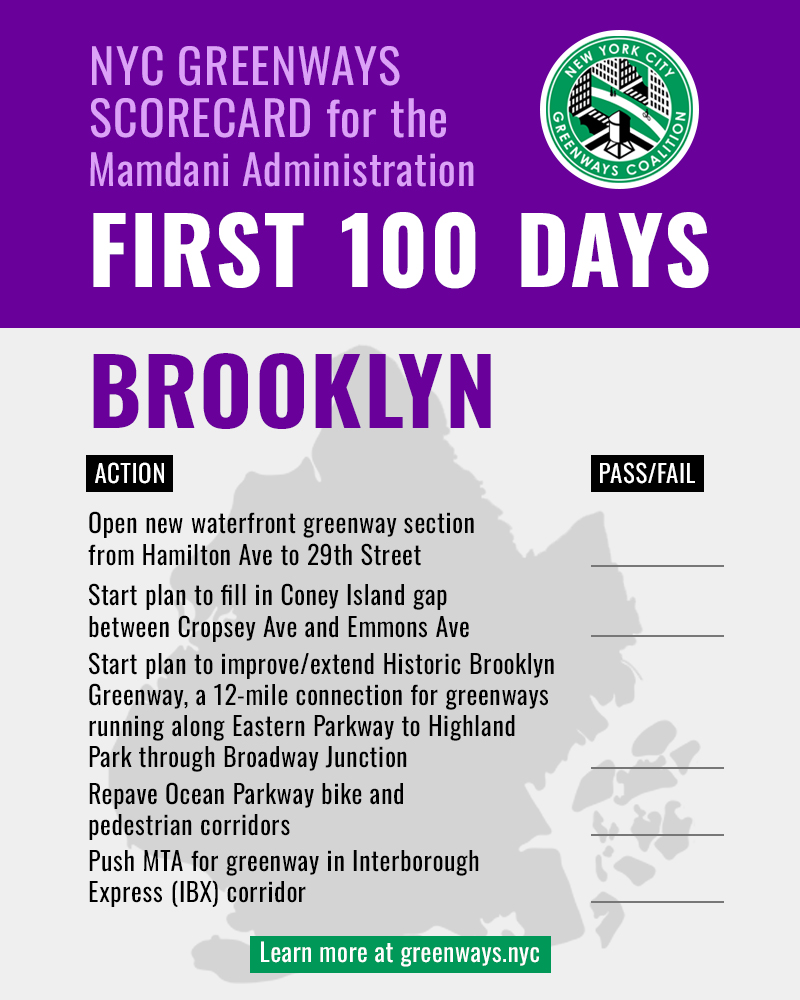
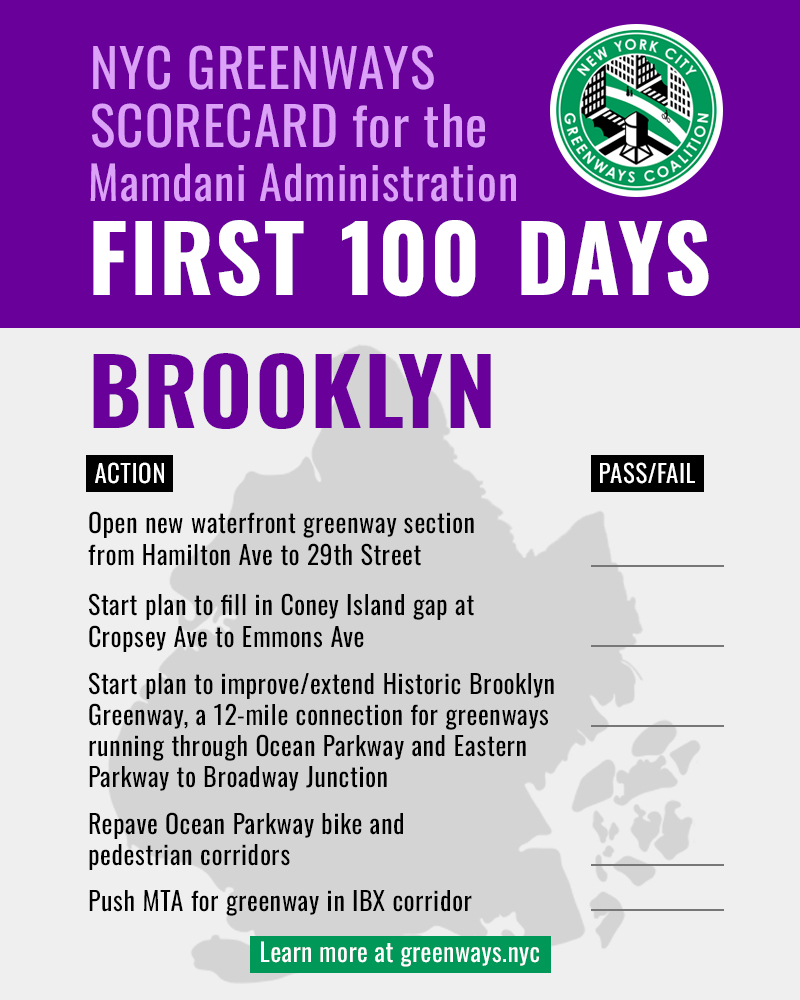
BROOKLYN
- Open new waterfront greenway section from Hamilton Ave to 29th Street
- Start plan to fill in Coney Island gap between Cropsey Ave and Emmons Ave
- Start plan to improve/extend Historic Brooklyn Greenway, a 12-mile connection for greenways running along Eastern Parkway to Highland Park through Broadway Junction
- Repave Ocean Parkway bike and pedestrian corridors
- Push MTA for greenway in Interborough Express (IBX) corridor
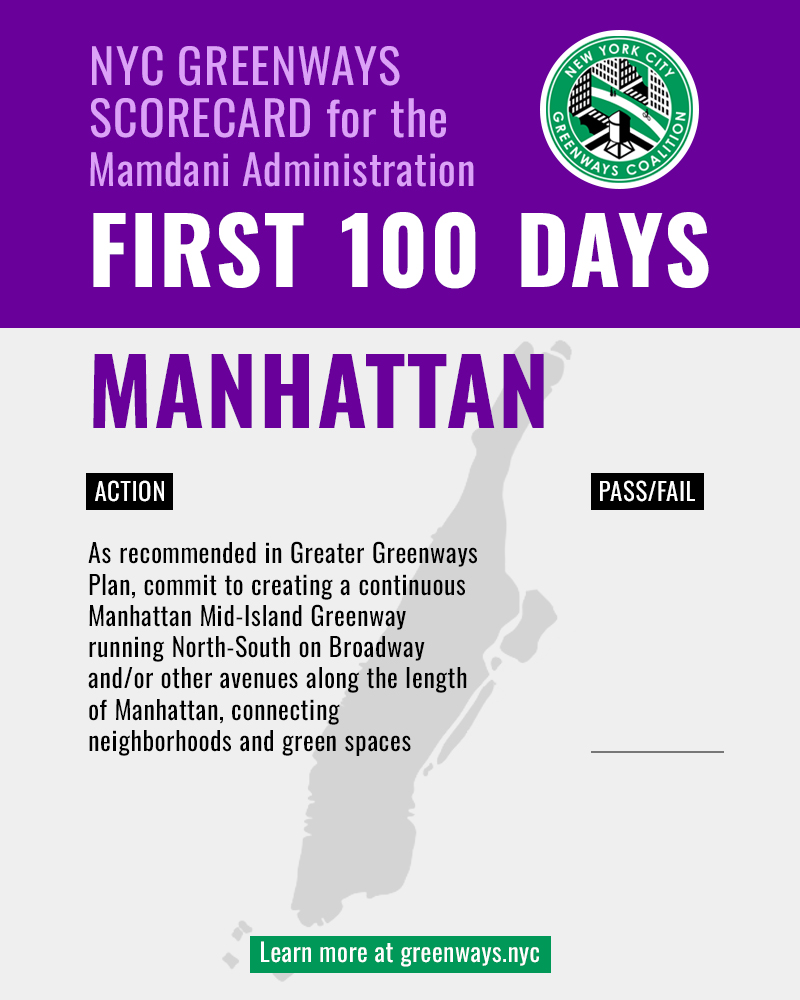
MANHATTAN
- As recommended in Greater Greenways Plan, commit to creating a continuous Manhattan Mid-Island Greenway running North-South on Broadway and/or other avenues along the length of Manhattan, connecting neighborhoods and green spaces
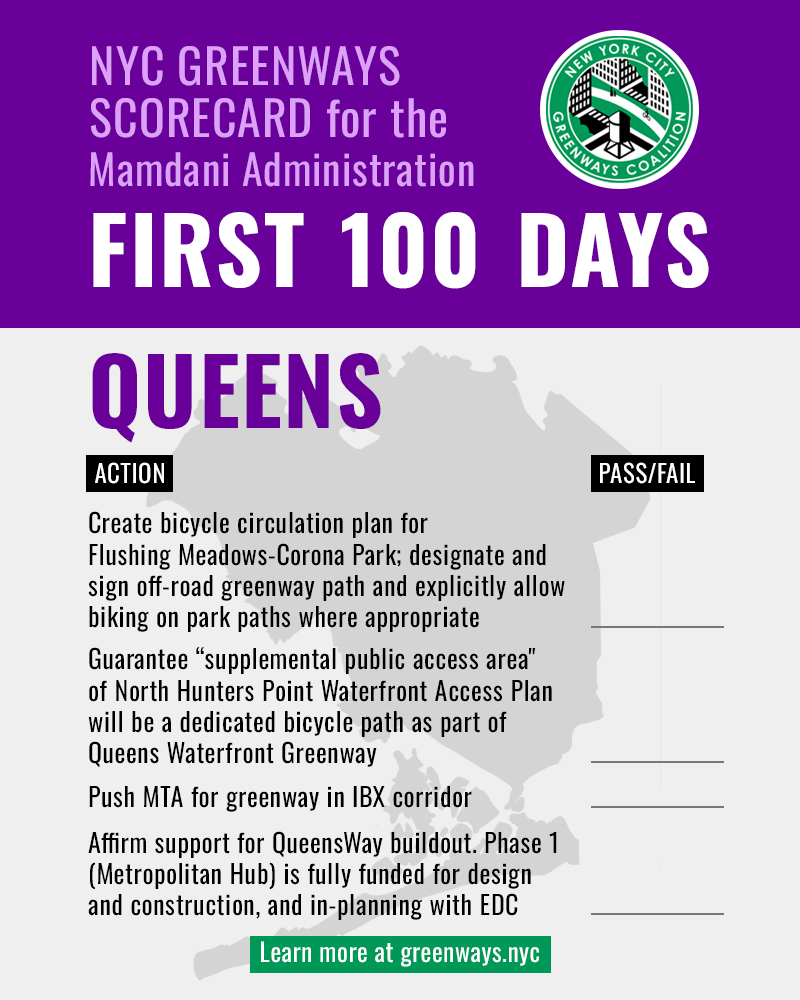
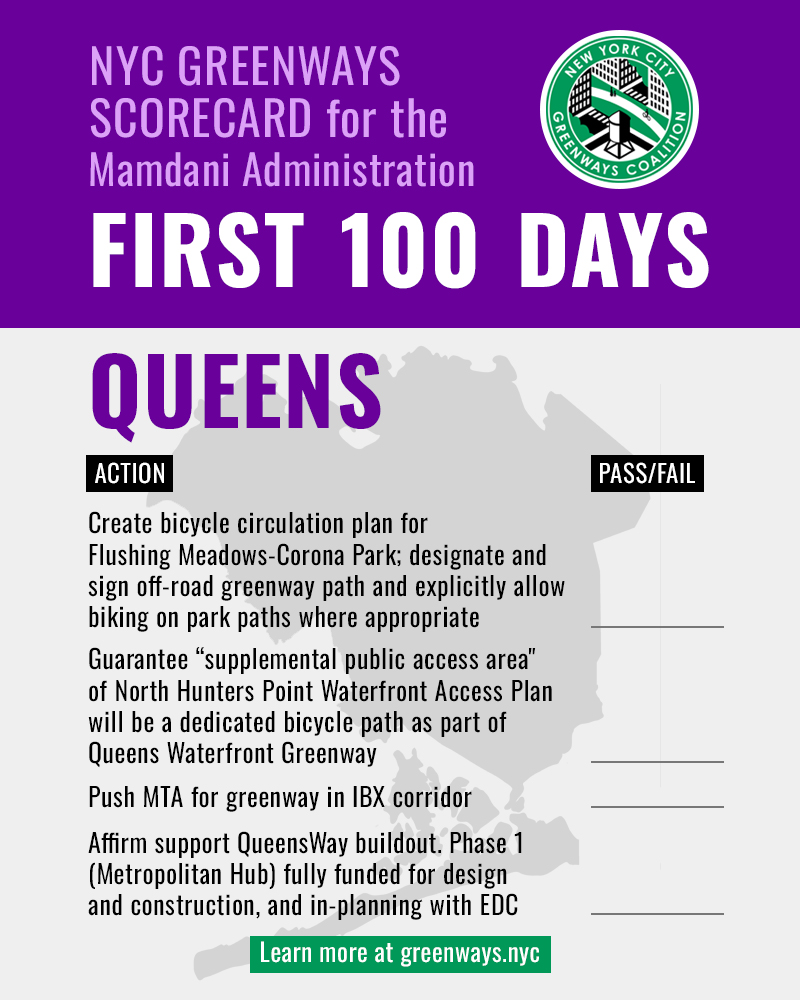
QUEENS
- Create bicycle circulation plan for Flushing Meadows-Corona Park; designate and sign off-road greenway path and explicitly allow biking on park paths where appropriate
- Guarantee “supplemental public access area” of North Hunters Point Waterfront Access Plan will be a dedicated bicycle path as part of Queens Waterfront Greenway
- Push MTA for greenway in Interborough Express (IBX) corridor
- Affirm support for QueensWay buildout. Phase 1 (Metropolitan Hub) is fully funded for design and construction, and in-planning with EDC
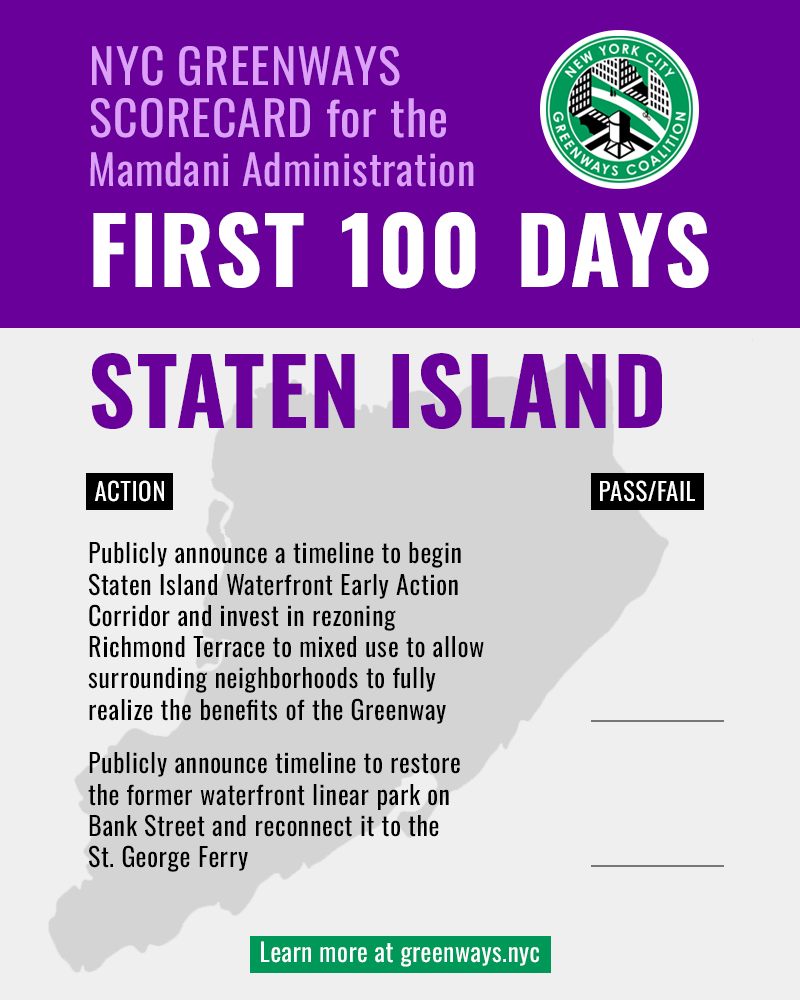
STATEN ISLAND
- Publicly announce a timeline to begin Staten Island Waterfront Early Action Corridor and invest in rezoning Richmond Terrace to mixed use to allow surrounding neighborhoods to fully realize the benefits of the Greenway
- Publicly announce timeline to restore the former waterfront linear park on Bank Street and reconnect it to the St. George Ferry
BEYOND THE FIRST 100 DAYS
FIRST YEAR
CITYWIDE
- Improve and incorporate greenways into NYC bike information tools such as NYCDOT Bike Map and bike lane closure map
THE BRONX
- Implement safety redesigns for high-stress greenway gaps and road and highway crossings such as Mosholu-Pelham Greenway crossings of Hutchinson River Parkway and Shore Road and Macombs Dam Bridge
- Build 132nd Street pier as first step in South Bronx Waterfront Greenway
- For South Bronx and Harlem River Greenways, fund and build the parts that are already in parkland, but have become derelict.
BROOKLYN
- Break ground on 29th-39th Street segment of waterfront greenway, and identify right of way and finalize design to fill in greenway gap (39th to 58th Street)
- Begin capital improvements for Destination Greenways (Leif Ericson and Shore Park)
- Release implementation plans for Historic Brooklyn Greenway and Brooklyn Waterfront Gaps in Coney Island and Sunset Park. Complete protected bike lane on Neptune Ave to connect Shore Parkway and Jamaica Bay greenways.
- Finish capital improvements to increase capacity and safety on Kent Ave
MANHATTAN
- Connect the existing protected bike lanes on East 61st and 62nd Streets to the Central Park Loop
- Initiate a design and feasibility study of Lighthouse Link to create an accessible overwater connection between the Lower Hudson River Greenway at the Little Red Lighthouse and the “dead end” section of the Greenway near 187th St
- Create alternate routes and detours for Hudson River Greenway in preparation for closures and capital projects by exploring adding biking and walking infrastructure on Henry Hudson Parkway and/or Riverside Drive
- Fix greenway gap and problem area between East Side Greenway south of Pier 11 and Peter Minuit Plaza
- Develop protected detour for segments of the Chinatown/Two Bridges waterfront where there is no longer access to waterfront promenade due to construction
QUEENS
- Announce clear time frames for implementation of Parks & DOT Destination Greenways projects in Queens, first announced in 2021
- Begin working with NY State on extending Vanderbilt Motor Parkway through Creedmoor site to connect to Long Island Greenway
- Extend protected bike lane design on 20th Ave in Steinway eastward to Hazen Street. Fix gaps in protection on Vernon Boulevard at Queensbridge Park and at Pulaski Bridge exit onto Jackson Avenue and 11th Street
STATEN ISLAND
- Create a quick-build, fully protected active transportation corridor connecting Goethals Bridge, Bayonne Bridge, and St George Ferry Terminal
- Connect Staten Island North Shore Greenway and Goethals and Bayonne Bridges to New Springville Greenway and Staten Island Waterfront Greenway
FIRST TERM
CITYWIDE
- Start building the Early Action Corridor (Harlem River – Bronx; Queens Waterfront; Historic Brooklyn; Staten Island Waterfront; South Bronx; Eastern Queens)
- Identify and close gaps in the greenway network
> Fund at least 20 greenway gap connector projects, including Notable Gaps identified in the Greater Greenways Plan and at bridges connecting greenways
> Create and advance greenway bridges program within DOT focused on planning, designing, and building bike and pedestrian bridges, overpasses, and underpasses that safely bypass highways, interchanges, and short waterways to connect critical segments of the greenway network - Prioritize greenways in underserved neighborhoods. At least 50% of greenway funding goes to low-income and disinvested communities (as defined in Environmental Justice NYC map)
THE BRONX
- Complete Harlem River Greenway and finalize Capital Plan for Harlem River Waterfront
- Create a capital plan to complete protected, continuous greenway segments linking Port Morris, Hunts Point, and the Randall’s Island Connector, prioritizing freight-heavy corridors for safety, shade, and flood-resilient design
- Working closely with the community and NYSDOT, create practical and safe East-West active transportation connections across the Bronx as called for in the Reimagine the Cross Bronx study
- Work with MTA to create a Queens/Bronx connection via bridges
BROOKLYN
- Finish construction of Brooklyn Waterfront Greenway including gaps in Coney Island, Red Hook, and Sunset Park
- Finish Historic Brooklyn Greenway with improvements to Ocean and Eastern Parkways and greenway connection to Broadway Junction and Highland Park
MANHATTAN
- Make capital improvements to improve greenway quality and connectivity in Upper Manhattan, including Fort Washington
Greenway and Harlem River Greenway - Create a continuous, accessible connection between the Henry Hudson Bridge side path and the Hudson River Greenway (as outlined in Greater Greenways Plan)
QUEENS
- Begin construction on at least 50% of Queens Waterfront Greenway
- Upgrade Queens Boulevard to full Greenway status by incorporating green infrastructure and public realm upgrades


.